
Geneviève Fortin, Staff Writer.
You already own three foundations that seemed right in the store and wrong by noon. One oxidized orange by lunch. One sat in your pores by mid-afternoon. One faded off your nose and chin but stayed put everywhere else, so you looked patchy in a work photo and couldn’t figure out why.
The question you actually type into a search bar at 11 p.m. isn’t “best foundation.” It’s closer to “why does my foundation disappear by 2 p.m.” or “why does foundation look grey on me after a few hours.” Those are mechanical problems, not shopping problems, and they have mechanical answers.
Here is the one fact worth knowing before anything else: a foundation’s wear time has almost nothing to do with its price and almost everything to do with how well its film-forming ingredients match your skin’s oil output and your skincare routine underneath. Get that pairing wrong and even a well-reviewed formula will fail on you within hours.
This guide walks through how these formulas actually work, how to read a label instead of a marketing claim, and how to test a foundation properly before you commit to a full bottle.
Finding Your Undertone In Daylight
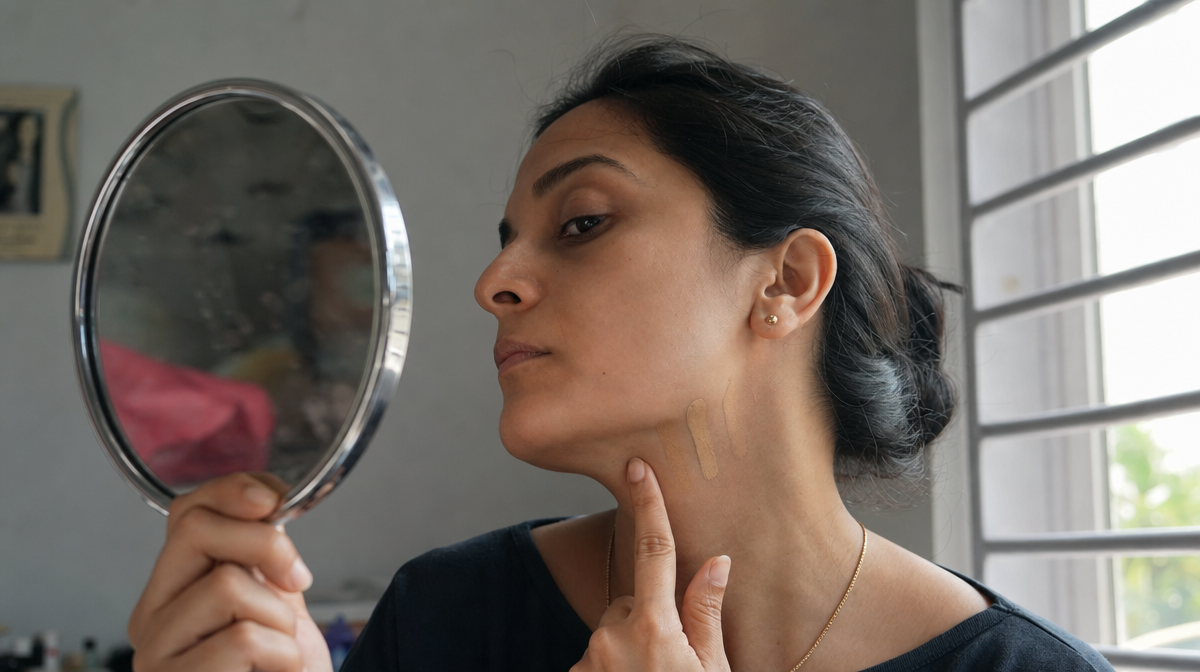
Store lighting is engineered to flatter, not to inform. Fluorescent and warm-toned bulbs shift how a foundation reads against your jawline, which is why so many women end up with a shade that looked perfect at the counter and looks chalky or orange at home.
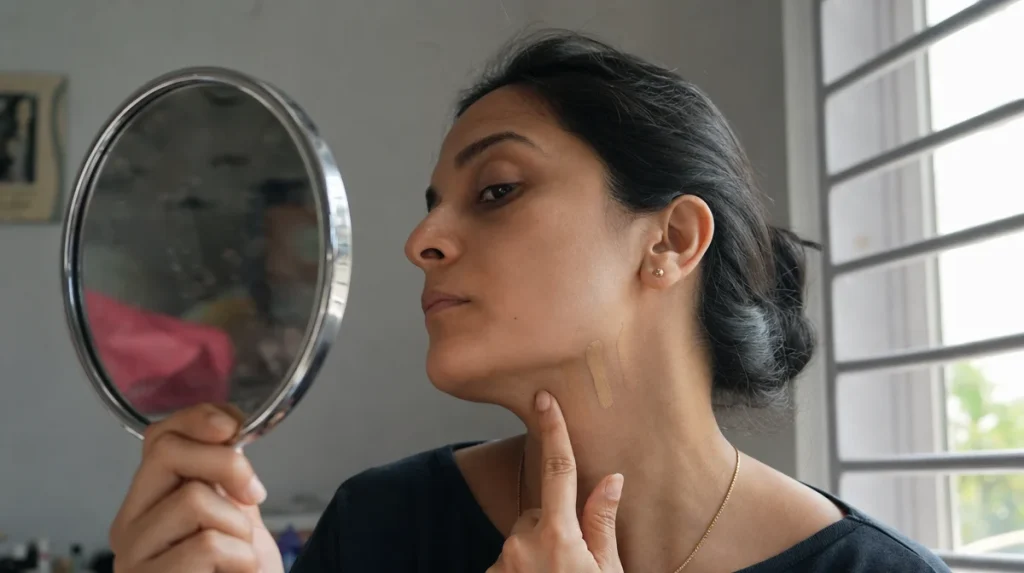
The fix is simple: test three shades along your jaw, not your hand, and step outside or stand at a window for thirty seconds before deciding. Daylight is the only consistent reference point, because it doesn’t have a colour cast of its own.
Undertone (whether your skin leans warm, cool, or neutral) is separate from depth (how light or dark your skin is). A common mistake is chasing undertone by looking at wrist veins, which actually reflects vein thickness and skin thinness more than pigment. A more reliable self-test: hold a piece of silver and a piece of gold jewellery against your jaw in daylight. Most people find one visibly flatters more than the other, and that’s a rough proxy for undertone that costs nothing to try.
What “Long-wear” Actually Means, Mechanically
“Long-wear” is a marketing category, not a regulated standard, so it helps to understand what’s happening on your skin underneath the label.
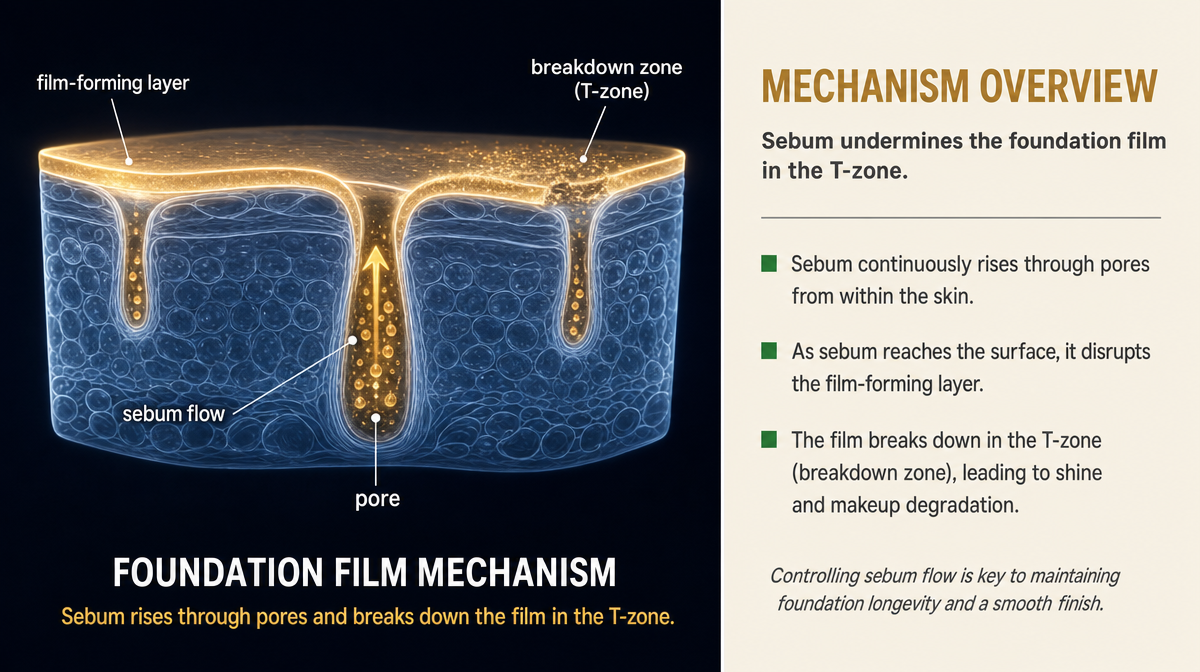
Most long-wear liquid foundations rely on film-forming polymers, ingredients that dry down into a thin, flexible layer on the skin’s surface rather than sitting as a wet film indefinitely. Think of it the way a coat of varnish behaves on wood: wet, it can smudge with a touch; once it cures, it resists smudging but can still crack if the surface underneath moves too much or gets too oily.
Your skin is the “wood” in that analogy. If it produces a lot of sebum through the day, that oil pushes up from underneath and breaks the polymer film apart in the T-zone first, which is why foundation tends to fail there before anywhere else. A 2021 study in the International Journal of Cosmetic Science measured this directly, tracking sebum output against foundation breakdown patterns on the forehead and nose over eight hours and finding a consistent correlation between oil production and visible fading.
This is why the same bottle can last all day on one person and slide off another by 1 p.m. It isn’t really about the product’s quality in isolation. It’s about the match between the film-forming system and your skin’s oil behaviour.
Reading The Ingredient List Without A Chemistry Degree
You don’t need to memorize INCI names, but a few categories tell you almost everything about how a formula will behave.
Silicones (ingredients ending in -cone or -siloxane, such as dimethicone) usually appear near the top of long-wear formulas. They create the smooth, blurred finish and help the film resist water and light sweat. They are not inherently good or bad for skin; they simply sit on top rather than absorbing.
Humectants like glycerin or hyaluronic acid pull moisture into the formula and can help prevent the caking that happens when a matte finish dries out too fast, particularly in dry indoor air.
Alcohol denat., listed higher up, speeds drying and can intensify wear but may also intensify dryness or a stripped feeling for some skin types over the course of a day. It is not automatically a red flag, but it is worth noticing if your skin tends to feel tight by afternoon.
A quick self-test: if you can pull up a formula’s ingredient list on your phone before buying, look for where these categories fall. Ingredients are listed in descending order by concentration, so what’s near the top does more work in the finished product than what’s near the bottom.
The Patch Test Everyone Skips
Most people test foundation shade, almost nobody tests foundation behaviour, and that’s the more expensive mistake.
Before committing to a full bottle, apply a small amount along your jaw or inner forearm and leave it through a normal day, including whatever skincare, sunscreen, and activity level you’d actually have on. Check it at three points: after two hours, after six hours, and before bed.
What you’re watching for is not just fading, but how it fades. Does it separate into patches, sink into fine lines, or oxidize to a different colour than it started? Each of those points to a different mismatch: patchy fading usually means an oil imbalance, sinking into lines often means the formula is too dry for that area, and oxidizing (turning more orange or grey over hours) usually means a pH or oil reaction between the formula and your specific skin chemistry.
A 2020 consumer survey referenced by Canadian Living found that a majority of respondents had returned or abandoned a foundation within the first two weeks of purchase, most citing wear performance rather than shade match as the reason. That gap between how a product performs on day one and how it performs after real wear is exactly what a proper patch test is meant to catch before you’ve committed to a full-size bottle.
Matching Finish To Skin Type, Not To Trend
Matte finishes are marketed heavily because they photograph cleanly, but matte formulas are built around oil-absorbing ingredients such as silica or clay derivatives, and on genuinely dry skin they can settle into texture and emphasize flaking rather than smoothing it.
Dewy or satin finishes tend to include more emollients and fewer mattifying agents, which suits drier skin but can look and feel heavy on oilier skin by midday, especially layered over a heavier moisturizer.
A practical way to judge this on yourself rather than by category: blot a clean, bare cheek with a piece of tissue or blotting paper mid-morning, before any product. Visible oil on the paper within a few hours of moisturizing points toward an oilier skin type that will likely do better with a mattifying formula. Little to no oil after several hours suggests drier skin that will likely look better, and last longer, in a dewier finish.
The Canadian Dermatology Association’s public skincare guidance notes that skin type can also shift seasonally, particularly with Canadian winters and forced-air heating, so a formula that worked well in July may behave differently in January on the same skin.
Application Mistakes That Shorten Wear Time
The single most common wear-time mistake isn’t the foundation at all: it’s skipping a proper drying period between skincare and makeup. Applying foundation over a moisturizer or sunscreen that hasn’t fully absorbed dilutes the film-forming ingredients and gives them a wet surface to slide on rather than skin to grip.
A second common error is using too much product to compensate for perceived poor coverage, which paradoxically makes a formula wear worse: thicker layers take longer to set and are more prone to creasing into fine lines and cracking under movement.
Third, tools matter more than people expect. A damp makeup sponge presses foundation into skin rather than dragging it across the surface, which tends to extend wear compared with a dry brush, particularly around the nose and under the eyes where creasing shows first.
A short household analogy: applying foundation over unabsorbed moisturizer is a little like painting a wall before the primer has dried. The colour goes on, but it won’t hold, and it will show every imperfection underneath sooner than it should.
What’s Marketing And What Actually Matters
Claims like “24-hour wear” or “transfer-resistant” are tested under laboratory conditions, typically on a stationary panel in a climate-controlled room, which has little in common with a Canadian commute, an air-conditioned office, or an evening outdoors in July humidity. These numbers are a starting point for comparison between products, not a promise for your specific day.
Packaging language such as “clean,” “dermatologist-developed,” or “medical-grade” has no consistent regulatory definition in Canada and can mean very different things between brands. What does matter, and what you can verify yourself, is the ingredient order discussed earlier and whether a formula is labeled non-comedogenic, which at least signals the manufacturer tested it against pore-clogging potential, even though that label isn’t independently regulated either.
Price is a weak predictor of wear performance on its own. Formulation chemistry, not cost, determines how a product behaves on your specific skin, which is part of why the patch test matters more than the marketing copy on the box.
Judging Results Honestly, And When To Stop Testing
Give a new foundation a genuine trial before judging it: at least three separate wear days, ideally including one higher-activity day and one low-activity day, since sweat and movement change how any formula performs.
Look for consistency more than perfection. A formula that fades evenly across the whole face by hour eight is behaving predictably and can often be managed with a midday touch-up in one area. A formula that fades unevenly, patchily, or changes colour is telling you it’s mismatched to your skin chemistry, not that you’re applying it wrong.
If a foundation consistently causes breakouts, stinging, or a rash along the jaw within the first week, that’s a different problem entirely and worth mentioning to a pharmacist or dermatologist rather than troubleshooting further, since it may point to a specific ingredient sensitivity rather than a wear issue.
Key Takeaways
Wear time is a chemistry match, not a price point. The same formula performs differently depending on your skin’s oil output, the skincare underneath it, and how it’s applied.
Test before you commit: a jawline patch test through one full real day tells you more than any counter demo or online review ever will.
Read ingredient order, not marketing copy, and match finish to your actual oil levels rather than to what looks best in photos.
A Short Practical Checklist
- Swatch and check shade in daylight, on the jaw, not the hand
- Patch test on a normal day, checking at two, six, and twelve hours
- Note whether fading is even, patchy, or a colour shift
- Check ingredient order for silicones, humectants, and alcohol denat.
- Blot bare skin mid-morning to confirm oily, dry, or combination behaviour
- Let skincare fully absorb before applying foundation
- Apply with a damp sponge if wear time is a recurring problem
- Reassess seasonally, since heating and humidity change skin behaviour
This article is general information and does not replace advice from a dermatologist or pharmacist.
Individual skin response varies, and results described here may not apply to every skin type.