

Dr. Priya Nandakumar, Senior Health and Science Editor.
You are standing in front of the bathroom mirror at eleven at night, and the little basket under the sink has three half-used cleansers, a silicone pad someone gave you at Christmas, and a spinning brush with a dead battery you keep meaning to charge. You type the same question into your phone every few months: does a cleansing brush actually do anything, or is it just an expensive way to scrub your face raw. Fair question. The honest answer is that a brush can genuinely lift more from the skin’s surface than fingers alone, but only if the bristles, the pressure and the timing are right. A 2019 study in the Journal of Cosmetic Dermatology found that sonic cleansing devices removed visibly more makeup and sebum residue than manual washing in the same sixty seconds, but the gap narrowed sharply once the manual group used a proper double-cleanse. In other words: the device helps, but technique still does most of the work. This guide walks through what these tools actually do, how to pick one that suits your skin rather than your Instagram feed, and where the marketing gets ahead of the evidence.
- A brush is a mechanical assist, not a treatment: it improves how well cleanser is distributed and lifted off, it does not replace active ingredients or a skincare routine.
- Bristle softness and spin speed matter more than the brand name on the handle: harder bristles and higher speeds do not clean better, they just irritate faster.
- Twice a week is plenty for most people: daily use is the single most common mistake, and it is the one most likely to leave skin red, tight or breaking out.
What A Cleansing Brush Is Actually Doing To Your Skin
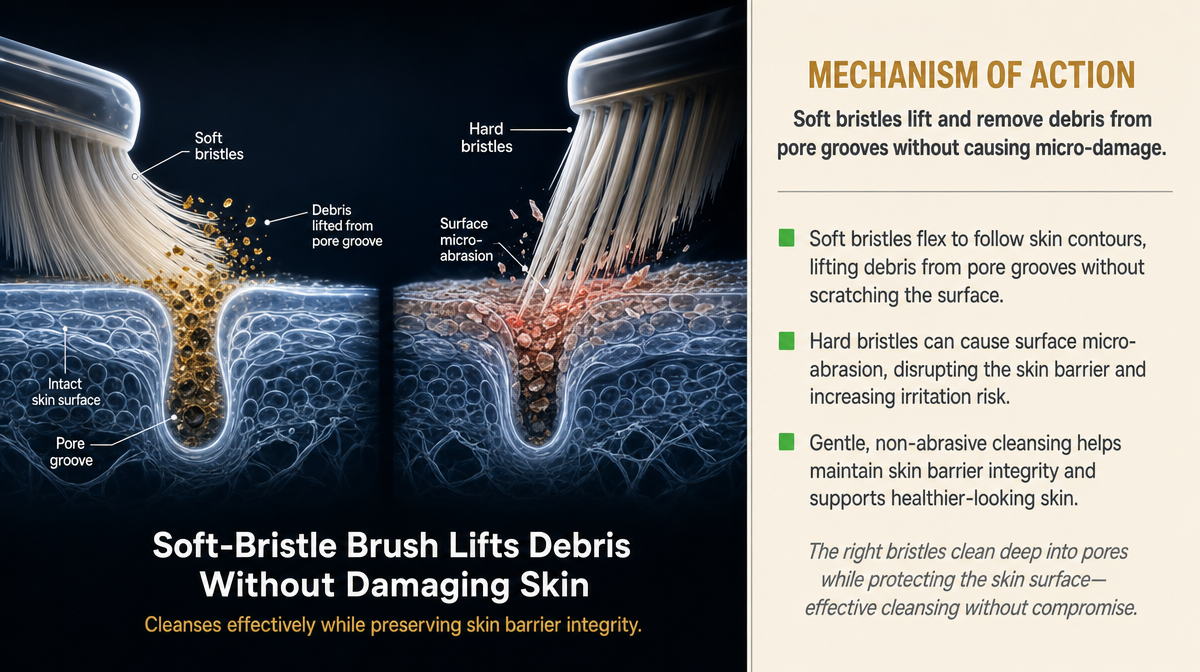
Picture washing a dinner plate with a soft cloth versus a bristle brush. Both remove grease, but the brush reaches into the tiny grooves the cloth glides over. Facial skin has its own version of those grooves: pores, fine texture, the creases beside the nose. A rotating or sonic brush agitates cleanser into those spaces mechanically, which is why users often report a smoother feel afterward.
That mechanical action is the entire mechanism. There is no active ingredient in the bristle itself. Whatever benefit you get comes from combining the brush with a cleanser suited to your skin, not from the device working alone. Dermatologists sometimes describe this as exfoliation by friction rather than by chemistry, distinct from an acid toner or a scrub.
The distinction matters because friction, unlike a well-formulated acid, does not know when to stop. Skin’s outer barrier is a thin, living layer, not a static coating, and repeated over-brushing can visibly thin it faster than most people expect. A 2021 review in Skin Research and Technology noted that daily use of vibrating cleansing devices was associated with a measurable rise in transepidermal water loss over four weeks in a cohort of forty participants, a sign the barrier was working harder to hold onto moisture. The device was not the problem. The frequency was.
Reading Bristle Softness Before You Read The Price Tag
Bristle stiffness is usually the least advertised spec and the most important one. Silicone-tipped brushes tend to run softer than nylon-bristled heads, and within nylon heads, the diameter and length of each filament change how much drag it creates against skin.
A simple self-test works better than any label. Press the dry brush head lightly against the inside of your wrist, where skin resembles facial skin in thinness. If you feel scratching rather than a gentle push, that head is too aggressive for daily facial use, full stop.
People with visibly reactive or thin skin, including most people over fifty or anyone using a retinoid, generally do better with silicone or very soft nylon heads. Oilier, thicker skin can usually tolerate a firmer bristle without complaint, though ‘tolerate’ is not the same as ‘benefit from.’ Firmer is not an upgrade. It is a different tool for a different job, closer to what estheticians use for congested backs than what belongs on a cheek.
The Double-cleanse Habit That Makes Any Brush Work Better
Most of the disappointment people report with cleansing brushes traces back to a missing first step. Makeup, sunscreen and the day’s grime are largely oil-based, and water-based cleansers do not fully dissolve oil on the first pass. Running a brush through that residue mostly redistributes it rather than removing it.
The fix is a first cleanse with a balm, oil or micellar water, worked in with fingers, followed by a second cleanse with your regular gel or cream cleanser, this time with the brush. Two short cleanses outperform one long, hard one, and they put far less friction through the skin overall.
This is the step most tutorials skip because it is not about the device. It is worth doing even with your hands.
How Often Is Actually Enough

The instructions in the box rarely match what dermatology research supports. Two to three times a week is the range most clinical reviews land on for sonic and rotating brushes, with plain fingers or a soft cloth on the days between.
A short self-test after two weeks tells you if you have the frequency right: skin should feel clean and slightly soft, not tight, not shiny with irritation, and free of new small bumps along the jaw or hairline. If you see any of those signs, drop back to once a week before abandoning the device altogether.
Skin that is already compromised, whether from a recent chemical peel, active acne treatment, or sunburn, should skip mechanical brushing entirely until it has visibly recovered. This is one of the few places where the Canadian Dermatology Association’s general public guidance on gentle cleansing for compromised skin lines up exactly with what device manufacturers themselves often bury in small print.
Where The Marketing Runs Ahead Of The Evidence
Look closely at cleansing device packaging and you will see phrases like ‘deep pore cleansing’ or ‘removes ten times more makeup,’ figures that trace back to a single manufacturer-funded lab test, not an independent clinical trial. That does not mean the number is fabricated, only that it describes one test under one set of conditions, usually the most flattering one.
Claims about pore size are worth particular skepticism. Pores do not open and close like tiny doors, dermatologists have said this for years, and no brush, hot water or cold rinse changes their physical size. What a good cleanse can do is reduce the buildup of oil and dead skin that makes pores look larger, which is a real and visible effect, just not the one the marketing copy usually describes.
Editors at outlets like Chatelaine and Canadian Living have covered this gap between marketing language and dermatology for years, generally landing on the same advice: judge a device by how your skin behaves over several weeks, not by the adjectives on the box.
Judging Results Without Fooling Yourself
Skin improvement from a cleansing habit shows up slowly and unevenly, which makes it easy to misread. The most reliable way to track it is a weekly photo taken in the same spot near a window, same time of day, no filter. Texture and tone changes are far easier to see across four photos spread over a month than they are day to day in a mirror.
Give any new cleansing routine four to six weeks before deciding it works or does not. Skin cell turnover, the process by which the surface layer renews itself, runs roughly four weeks in younger adults and slows with age, so anything faster than that is likely just a temporary change in oiliness, not a real shift in skin condition.
If redness, stinging or new breakouts appear within the first week, that is not ‘purging,’ a term borrowed from acid exfoliants and often misapplied to mechanical brushing. It is irritation, and the honest response is to reduce frequency or bristle stiffness, not push through it.
Cleaning The Brush Itself
A cleansing brush that is not cleaned becomes, over a few weeks, a small reservoir for the same bacteria and oil it was meant to remove. Bristle heads should be rinsed under running water immediately after each use, left to air dry upright rather than face down, and swapped for a fresh head roughly every three months of regular use.
A damp bristle head sitting in a closed shower caddy is one of the more overlooked hygiene gaps in a skincare routine, and it is worth checking today, not after reading the rest of this article.
Key Takeaways
A cleansing brush is a mechanical tool, not a treatment, and it works best paired with a proper double-cleanse rather than as a shortcut around one. Soft bristles suit most facial skin, and a simple wrist test can tell you in seconds whether a given head is too aggressive. Two to three uses a week is enough for most people, with plain hands or a soft cloth filling the gaps. Judge results over four to six weeks with consistent photos, not by how skin feels the morning after, and treat any early redness as a signal to ease off rather than a sign the product is ‘working.’
A Quick Checklist Before You Buy Or Reach For One Again
- Press the dry bristle head against your wrist: scratchy means too firm for facial use
- Double-cleanse first, brush second, always
- Limit use to two or three times a week unless your skin visibly tolerates more
- Skip the device entirely after a peel, sunburn or while on a retinoid
- Rinse and air-dry the head after every use, replace it every three months
- Track results with a weekly photo in consistent light, give it four to six weeks
- Treat redness or new breakouts as a signal to slow down, not push through
This article is intended for general information only and does not replace personalized advice from a dermatologist or healthcare provider.
Individual skin responses vary, and results described in cited studies may not reflect every person’s experience.