
Amanda Whitfield, Beauty Editor.
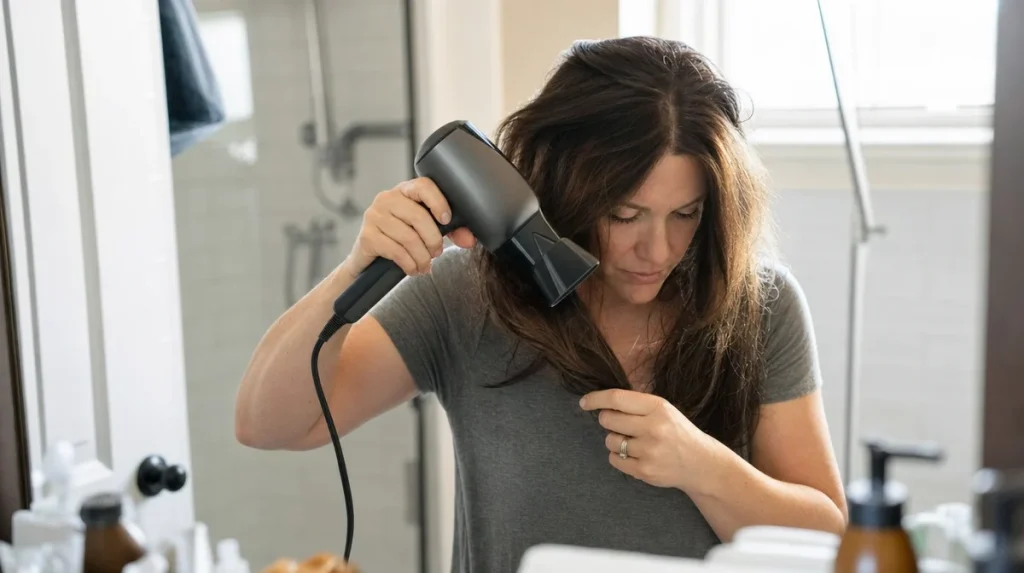
You are standing in front of the bathroom mirror on a humid Tuesday, dryer in hand, watching your hair puff out instead of lying smooth. Under the sink sit three half-finished bottles of frizz serum and a diffuser you never quite figured out how to use. At some point you typed some version of the same question into your phone: why does my hair frizz right after I dry it, even with a good dryer.
The honest answer has less to do with the serum and more to do with what happens in the first ninety seconds of heat and airflow hitting wet hair. Specialists who study hair and heat styling do not start by asking whether a dryer is “ionic.” They start by asking how it actually moves water off the strand. One useful fact before anything else: a dryer that emits negative ions is trying to break large water droplets into smaller ones so they evaporate faster, with less mechanical roughing-up of the outer cuticle layer. That single mechanism explains most of what follows, including why some ionic dryers leave fine hair flat while others leave coarse hair glossy.
This guide walks through what actually matters when judging one of these tools, the mistakes almost everyone makes with heat and distance, and how to tell, over real use, whether a dryer is doing its job.
- Wattage predicts drying speed better than the word “ionic” on the box, check the number before the marketing claim.
- Too much ionization can flatten fine hair, so more negative ions is not automatically better for every hair type.
- Nozzle angle matters as much as heat setting, airflow pointed down the hair shaft smooths the cuticle instead of lifting it.
What The Ions Are Actually Doing To Your Hair
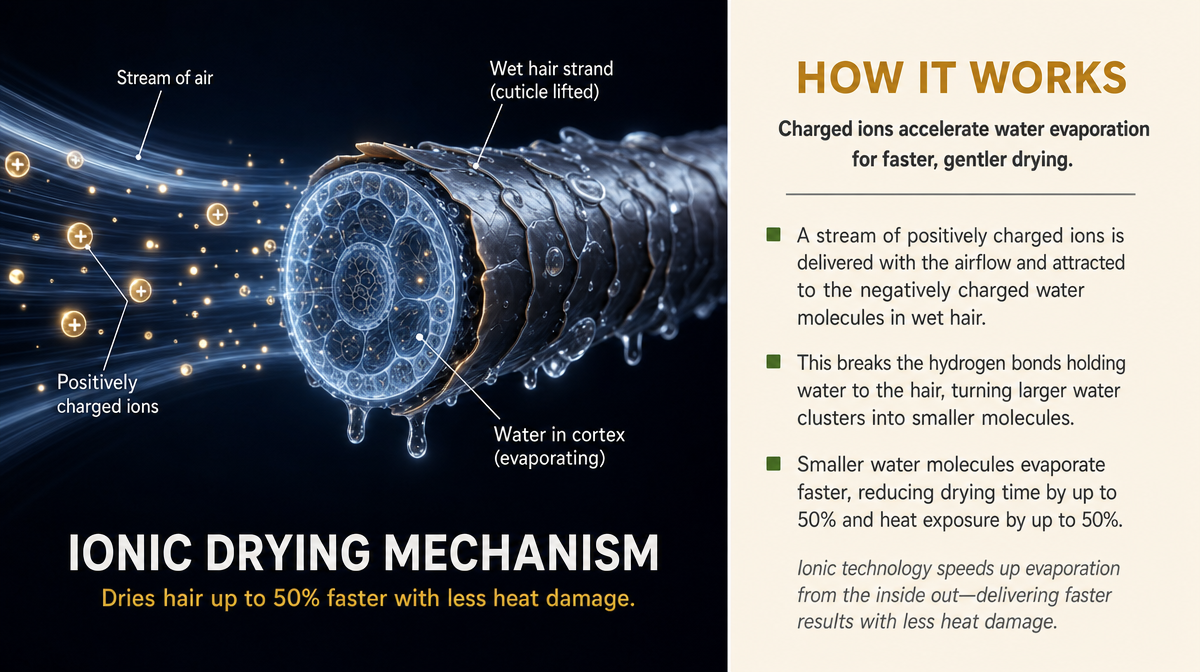
Wet hair carries a slight electrical charge as water evaporates unevenly off the strand, which is part of why hair can look ragged and frizzy as it dries on its own. A negative-ion dryer releases charged particles into the airflow that attach to water molecules on the hair, breaking larger droplets into a finer mist. A 2011 study in the International Journal of Cosmetic Science measured this effect under laboratory conditions and found that ionization may shorten drying time by encouraging water to evaporate in smaller, more evenly distributed droplets, rather than sitting in larger pools that force the cuticle to lift as they dry.
Think of it the way a dryer sheet works in a load of laundry. The sheet does not remove static from the fabric so much as neutralize the charge that causes fibres to cling and frizz against each other. Ionic dryers are attempting something similar on a wet strand: neutralizing the imbalance so water leaves the hair in a calmer, more predictable way instead of an uneven scramble.
This is why the ion claim alone tells you very little. What matters is whether the ion output is paired with enough airflow and heat control to make use of it.
Reading The Wattage Number Before The Ionic Claim
Before anything about ion counts, specialists look at wattage, because wattage governs how much heat and air the motor can push out, which is the actual work of drying hair. Most full-size dryers sold in Canada sit somewhere between 1,600 and 2,200 watts. A travel dryer at 1,000 watts can carry an ionic label and still take twice as long to dry a shoulder-length head of hair, because the motor simply cannot move enough warm air.
A useful comparison is a kitchen stove. A burner rated at a lower output can still get a pot to boiling eventually, but it takes longer and the food at the edges cooks unevenly while the centre catches up. A low-wattage dryer behaves the same way on hair: the sections you finish first have already cooled and re-absorbed some moisture from the air by the time you reach the back.
The common mistake is buying a compact or travel dryer for daily use because it is light and quiet, then blaming frizz on the wrong feature. Check the wattage on the packaging or the barrel itself before looking at anything else. If it is not printed anywhere, that is itself worth noting.
Matching Heat And Speed Settings To Your Hair Type
Fine hair and coarse or curly hair are not drying under the same conditions even when they are in front of the same dryer. Fine strands have less mass and heat up quickly, so a high heat setting can scorch the cuticle in the time it takes to notice. Coarse and curly hair holds more water in its structure and often needs sustained, moderate heat over a longer stretch to dry through the mid-shaft, not just the surface.
The Canadian Dermatology Association’s general public guidance on heat styling notes that repeated high-heat exposure close to the scalp can contribute to dryness and irritation over time, and recommends keeping styling tools on the lowest effective heat setting for the desired result. That advice maps directly onto dryer settings: fine hair usually does better on low or medium heat with high airflow speed, which moves air fast enough to dry without holding heat in one place. Coarse hair often needs medium-to-high heat but benefits from a diffuser attachment that spreads the airflow rather than concentrating it.
The mistake is treating the highest heat setting as the fastest, most efficient option regardless of hair type. It is faster only in the sense that it damages the cuticle before you notice the hair is actually dry.
Using The Concentrator Nozzle Correctly
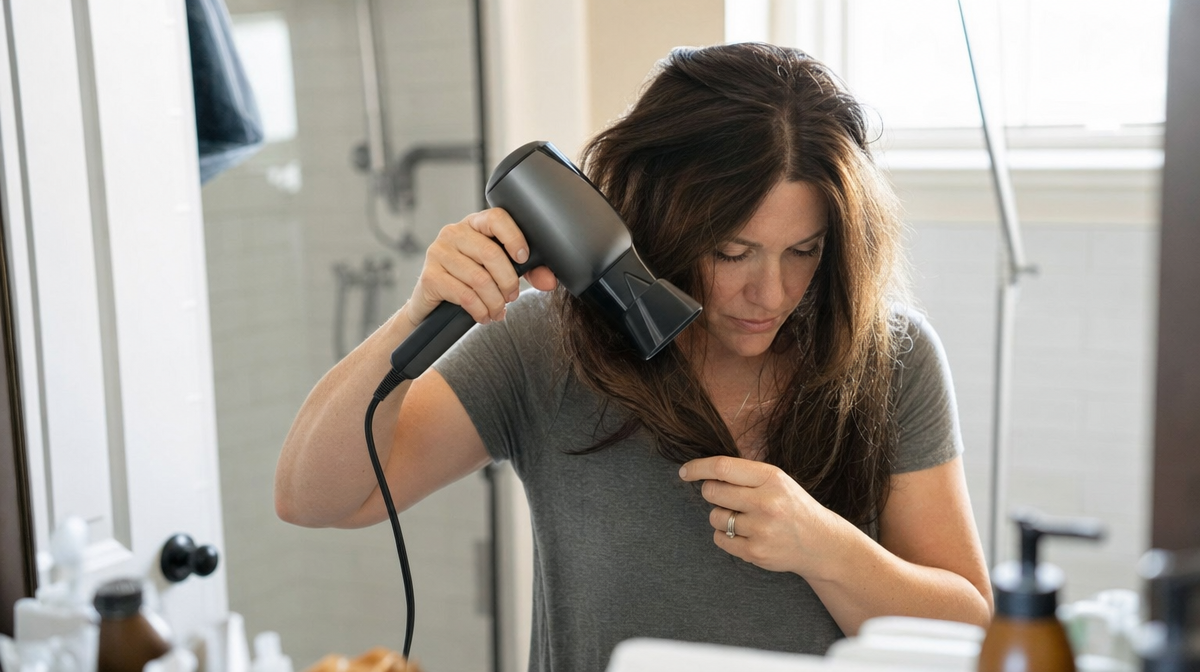
The narrow attachment that comes with most dryers is called a concentrator, and how you hold it matters more than most people assume. Hair cuticle scales lie flat when smoothed in one direction, roughly from the scalp toward the ends, the same way a cat’s fur lies smooth when stroked from head to tail and bristles when stroked the other way.
Aiming the concentrator down the length of the hair shaft, following that same direction, keeps the cuticle scales flat as they dry, which is part of what produces shine and reduces frizz. Aiming it upward from underneath, or moving it in quick back-and-forth motions across a section, lifts the scales and roughens the surface, which is one of the more common and least noticed causes of frizz that has nothing to do with the dryer’s ion output at all.
A simple self-test: dry one small section of hair holding the nozzle angled down the shaft, and a comparable section aiming the airflow straight on or slightly upward. Run a hand over each once cool. The section dried with downward airflow will generally feel smoother to the touch.
The Distance And Timing Mistakes That Undo Good Settings
Even a well-matched heat setting can cause damage if the dryer sits too close to the scalp or lingers on one section too long. A distance of roughly 15 centimetres, about the width of an open hand, is a commonly cited reference point for keeping the dryer far enough away that heat does not concentrate on one patch of scalp or hair.
The more common mistake is not distance but dwell time: holding the dryer still on one section while multitasking, checking a phone or reaching for a brush, rather than keeping it in constant, slow motion. Hair that sits under a stationary heat source for even a few extra seconds loses more moisture than intended, which can leave it feeling brittle rather than merely dry.
Overdrying is also worth watching for on its own. Hair that is fully dry but continues to receive hot air for another minute or two is losing surface moisture it will need for flexibility and shine. A reasonable self-test is to stop drying as soon as a section feels dry to a light touch, rather than continuing until every strand looks perfectly styled, since a finishing brush or cool-shot button can usually handle the rest.
Judging Results Over Weeks, Not One Blow-dry
A single good hair day tells you very little about whether a dryer is genuinely reducing frizz or simply catching you on a low-humidity day. Beauty editors at longstanding Canadian service titles like Canadian Living have long advised judging styling tools across a run of uses and varied weather, not a single demonstration, precisely because humidity, hair washing products, and even the last haircut all affect how hair behaves on any given day.
A fair test runs for two to three weeks, tracking the same routine each time: same shampoo, similar humidity range if possible, same general drying method. What you are watching for is consistency, whether hair reaches a similar level of smoothness and shine across most of those sessions, not whether one exceptional blow-dry happened to look great.
It is also worth separating what a dryer can do from what a leave-in product or finishing serum is doing. If frizz reduction seems to depend heavily on a specific styling product used alongside the dryer, that is useful information about the product, not necessarily the dryer’s ion output or wattage.
Marketing Words That Sound Scientific But Say Little On Their Own
Terms like ceramic, tourmaline, and far-infrared appear on packaging because they describe real materials and heating methods, but on their own they say very little about performance. Ceramic and tourmaline coatings are generally understood to help distribute heat more evenly across the barrel rather than in hot spots, which can reduce the risk of scorching a section of hair. That is a real, modest benefit, but it does not substitute for adequate wattage or airflow.
The independent, non-profit consumer-testing magazine Protégez-Vous, which has published lab-based appliance reviews in Québec since 1973, has noted in its general appliance testing coverage that wattage and airflow measurements tend to correlate more reliably with actual drying performance than ion-count figures printed by manufacturers, which are rarely independently verified. That does not mean ionization does nothing; the laboratory evidence for the underlying mechanism is reasonably solid. It means the marketing number itself, unverified, tells a shopper very little compared with wattage and a hands-on sense of airflow strength.
The practical rule: treat coating names and ion claims as secondary details, useful as tie-breakers between two dryers that are already comparable in wattage and airflow, not as the primary basis for a decision.
A Two-minute Self-test With The Dryer You Already Own
Before assuming a dryer is underperforming, or deciding it needs replacing, a short hands-on check can clarify a lot. Hold a hand roughly 15 centimetres from the nozzle on the highest airflow setting. The air should feel like a steady, forceful push, not a thin stream that dissipates within a few centimetres. A weak stream at full speed usually points to a motor issue or a wattage that was never sufficient for the hair length being dried.
Next, listen and feel for cycling: many dryers have a thermostat that cuts heat briefly if the barrel gets too hot, which shows up as a slight pulsing in temperature. Occasional cycling on the highest heat setting is normal and is a safety feature, not a defect. Constant, rapid cycling, where the air alternates cool and hot every second or two, often signals the dryer is being pushed harder than its wattage comfortably allows.
Finally, check the nozzle attachment for a snug, secure fit. A loose concentrator lets air escape around the edges rather than through the narrow opening, weakening the directional airflow that keeps the cuticle smooth, regardless of how strong the motor itself is.
Key Takeaways
- Ion output explains a real mechanism, breaking water droplets into finer mist, but it cannot compensate for low wattage or weak airflow.
- Match heat and speed to hair type: lower heat and higher speed for fine hair, moderate-to-high heat with a diffuser for coarse or curly hair.
- Nozzle direction along the hair shaft matters as much as any setting on the dial.
- Judge frizz and shine claims over two to three weeks of varied weather, not a single blow-dry.
- Coating names and ion counts are reasonable tie-breakers between comparable dryers, not the main basis for a decision.
A Quick Checklist Before Your Next Blow-dry
- Check the wattage printed on the dryer before reading any ionic or ceramic claim.
- Set heat and speed based on hair type, not habit.
- Angle the nozzle down the hair shaft, from scalp toward ends.
- Keep the dryer moving, roughly a hand’s width from hair and scalp.
- Stop as soon as hair feels dry to a light touch, rather than continuing for a perfect finish.
- Give any new routine two to three weeks, across different humidity levels, before judging results.
This article is general information and does not replace advice from a dermatologist or trichologist for specific hair or scalp concerns.
Individual results from any hair-drying routine or tool vary by hair type, condition, and climate.