
Amanda Whitfield, Beauty Editor.
It is 3 p.m. and the makeup you carefully set at 7 a.m. has migrated: gone from your eyelids, pooled faintly along your nose, gone entirely from your chin. You bought the setting spray with the good reviews. You shook it, you sprayed it, and by lunch it had quietly given up. If you have ever stood in a washroom mirror wondering what you did wrong, the honest answer is usually not the product. It is one of a handful of habits that undo even a well-made spray before it gets the chance to work. A 2021 study in the International Journal of Cosmetic Science found that film-forming sprays need a specific drying window to form a continuous polymer layer, and that touching, rubbing or layering powder too soon can break that layer before it sets. Understanding that single mechanism changes almost everything about how you use the product you already own.
- Distance and drying time matter more than the formula: an even, six-to-eight-inch mist followed by 60 seconds of stillness does more for wear time than any specific ingredient.
- Skin prep decides half the outcome: an under-moisturized or under-primed face will absorb a setting spray unevenly no matter how good the product is.
- “All-day” claims describe lab conditions, not your day: heat, humidity, oil production and touching your face all shorten real-world wear regardless of the label.
What A Setting Spray Is Actually Doing To Your Skin
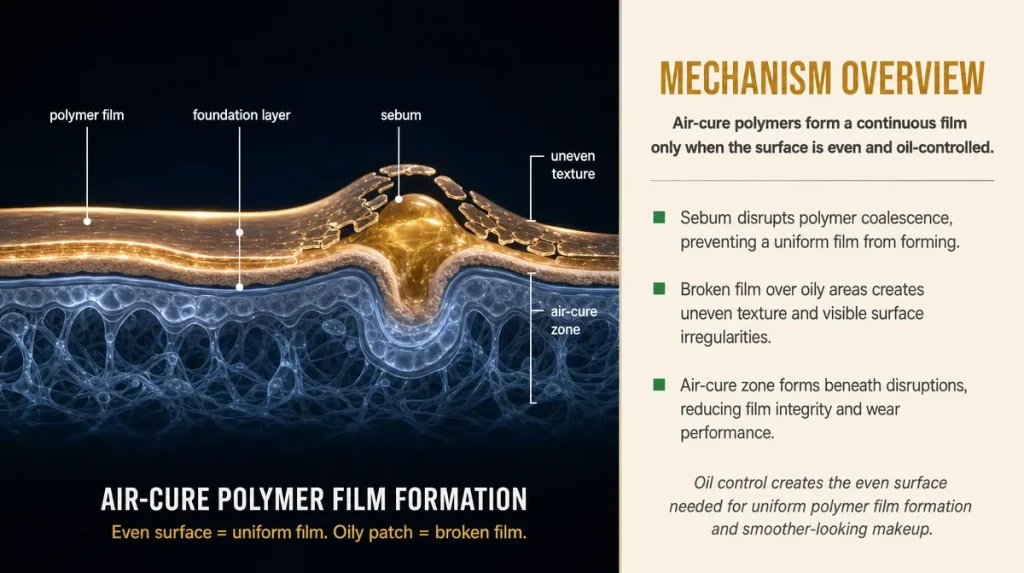
Most long-wear setting sprays work the way a thin coat of varnish works on wood: they lay down a nearly invisible polymer film across the makeup underneath, which slows the transfer of oil, sweat and moisture up through the layers. That film needs air contact to cure properly. Varnish that gets touched or stacked with another coat too soon stays soft and smudges. Setting spray behaves the same way.
The practical consequence is that the spray is not “holding” your makeup in a chemical sense so much as sealing a surface. If that surface was uneven, oily in patches or still wet with primer when you sprayed, the seal forms unevenly too, and it fails first in exactly those patches.
A 2021 study in the International Journal of Cosmetic Science, working with 42 participants over an 8-hour wear period, found that film formation was measurably weaker when the spray was applied to skin with visible surface oil versus blotted skin. The difference was not enormous, but it was consistent enough that the researchers flagged blotting as a meaningful pre-spray step.
This is worth sitting with because it reframes the whole category. A setting spray is not a rescue tool you reach for when makeup is already sliding. It is a sealing step that only works as well as the surface it is sealing.
Spraying From The Wrong Distance
The single most common mistake is holding the bottle too close. Most long-wear formulas are designed to be misted from roughly six to eight inches away, close enough for even coverage, far enough that the spray disperses into a fine cloud rather than landing as visible droplets.
Sprayed from two or three inches, the product comes out wetter and more concentrated in the spots it hits first, usually the centre of the face. That over-saturation can actually reactivate cream or liquid makeup underneath, smearing pigment rather than sealing it. You end up with streaky patches exactly where you sprayed hardest.
The fix is almost embarrassingly simple: hold the bottle at arm’s length, roughly the distance from your elbow to your wrist, and sweep it in a loose X or T shape across the face in one or two passes. One pass is usually enough. A second, lighter pass over the T-zone can help if you run oily there, but a third pass rarely adds wear time and often just adds tackiness.
Self-test: spray a tissue from your usual distance. If you see distinct wet dots rather than an even mist, you are too close.
Not Giving It Time To Dry Before You Move On
After misting, most people immediately reach for powder, blot with a tissue, or put on a hat, sunglasses or a mask. Every one of those actions interrupts the film while it is still curing.
Drying time depends on formula and humidity, but a reasonable general rule is to wait 60 seconds before touching your face again, and to avoid pressing powder or a sponge into freshly sprayed skin. If you must set concealer under the eyes after spraying, do it before the mist, not after.
Humidity slows drying further. In a warm, damp washroom, the same spray that sets in under a minute in a dry room can take two or three times longer, simply because the surrounding air is already saturated with moisture and cannot pull the spray’s carrier liquid off the skin as quickly.
A practical habit: spray as the last step before leaving the house, not the first step when you sit down to do your makeup, and use the walk to your car or the elevator ride as your drying window instead of standing at the mirror.
Layering Too Much, Or The Wrong Kind, Of Product Underneath
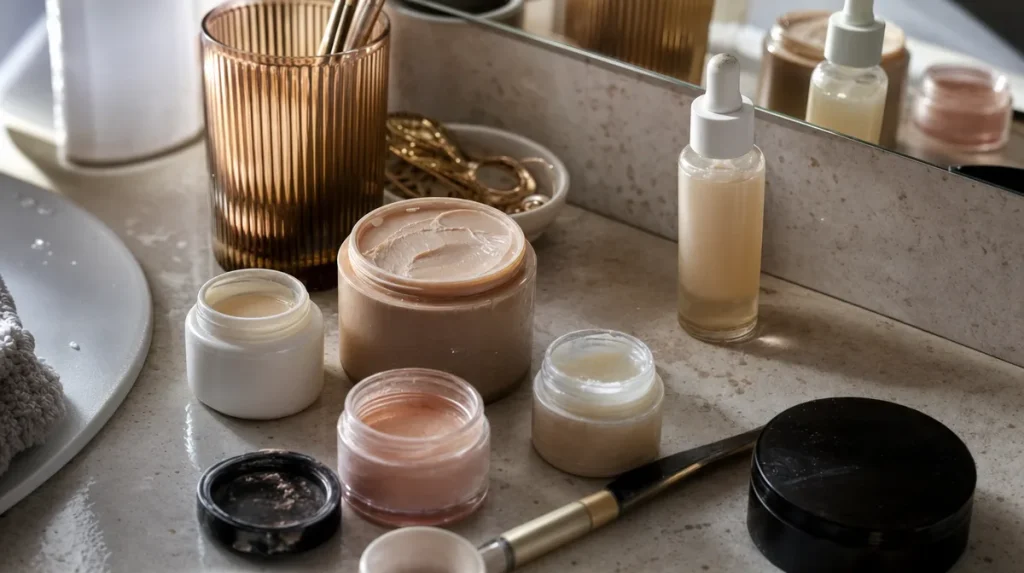
A setting spray cannot compensate for six layers of cream product underneath it. Every additional layer of foundation, concealer and cream contour adds oil and pigment that the thin polymer film has to sit on top of and hold in place. Ask that film to seal too much material and it behaves like plastic wrap stretched over an overfull container: it holds for a while, then it gives at the weakest point.
The household comparison that tends to land with readers is a bandage. A bandage seals a small, well-prepared area well. Wrap the same bandage around several loose layers of gauze and it will not hold nearly as long, no matter how good the adhesive is.
This is also where mixing a matte, oil-absorbing spray over a very dewy, oil-based foundation causes problems. The two formulas are chemically working against each other: one is trying to control oil, the other is delivering it. The result is often a slightly grey or patchy cast rather than a smooth matte finish.
If your base already includes several cream products, consider a lighter hand with the spray rather than a heavier one, since more spray on top of a heavy base tends to pill rather than seal.
Skipping Skin Prep And Blaming The Spray
A long-wear spray is the last five per cent of a routine, not a substitute for the other ninety-five. Skin that is under-moisturized tends to produce more oil later in the day as it tries to compensate, a pattern dermatology clinics commonly describe when patients report midday shine despite using “oil control” products. Skin that is over-moisturized or still tacky from a rich cream, on the other hand, will not let a primer or foundation grip properly in the first place.
The Canadian Dermatology Association’s public guidance on daily skin care routines notes that a well-matched moisturizer and adequate sun protection form the foundation that everything else sits on, a point echoed in general skincare coverage from Canadian Living. Neither source is discussing setting sprays specifically, but the underlying logic applies directly: a spray seals whatever state your skin and makeup are already in.
Before reaching for a new setting spray, it is worth troubleshooting backward: is your moisturizer suited to your skin’s actual oil level, are you using a primer suited to your pore size and texture, and are you letting each step sit for a minute before adding the next. Most “my setting spray does not work” complaints trace back to one of these three questions rather than the spray itself.
Reading The Label: What “24-Hour” And “Waterproof” Actually Mean
Claims like “24-hour wear” or “waterproof” are tested under controlled laboratory conditions, typically a fixed temperature, a fixed humidity, and a face that is not sweating, eating, touching itself or exposed to wind. Real days involve all four.
That does not make the claim false so much as incomplete. It describes a best-case scenario, similar to a car’s fuel economy rating: accurate under test conditions, optimistic in city traffic.
More useful than the number on the front of the bottle is the ingredient logic on the back. Formulas built around film-forming polymers such as those in the acrylate family tend to genuinely resist transfer and water contact. Formulas that lean mainly on alcohol for a quick-dry feel evaporate fast, which can feel like “setting,” but offer less actual sealing over time. Neither is inherently better, they simply suit different needs: alcohol-forward sprays often feel lighter and suit dry climates, while polymer-forward sprays tend to hold up better in heat and humidity.
Self-test: press a clean tissue firmly against your cheek eight hours after application. Heavy transfer suggests the film broke down; light or no transfer suggests it held, regardless of what the label promised.
Adjusting For Climate, Activity And Skin Type
A spray that performs beautifully in a dry, air-conditioned office may fail within two hours outdoors in humid August heat, and the reverse is also true. Humidity slows the drying and curing process described earlier, while dry heat can cause a film to become brittle and flake rather than stretch with facial movement.
Active days change the equation further. Sweat is not simply water, it also carries salts and oils to the skin’s surface, and a spray formulated mainly to resist water transfer may still struggle against oil-heavy sweat. If your day includes exercise, a commute on foot, or several hours outdoors, a lighter base with fewer cream layers generally lasts longer than a heavy one with more spray piled on top to compensate.
Skin type matters as much as weather. Oilier skin types generally benefit from a mattifying, oil-absorbing formula and a light hand with moisturizer beforehand, while drier skin types often do better with a hydrating mist-style spray that will not emphasize flaking. There is no single formula that performs identically across skin types and climates, which is part of why the same product earns wildly different reviews online.
A short seasonal habit worth building: reassess your setting spray choice each time you change your moisturizer for the season, rather than assuming one bottle should carry you through every month of the year.
Key Takeaways
Long-wear setting spray works by forming a thin film over your makeup, and that film only holds as well as the surface underneath it. Most failures trace back to application habits rather than the formula: spraying too close, moving too soon, layering too much cream product, or skipping proper skin prep beforehand. Lab claims like “24-hour” describe controlled conditions, not your actual day, so treat them as a starting point rather than a guarantee. Matching the formula type to your skin and the day’s climate matters more than chasing a higher number on the label.
A Quick Checklist Before You Spray
- Blot visible oil, do not press powder into wet product
- Hold the bottle six to eight inches away
- Mist in one or two light passes, not three or four
- Wait about 60 seconds before touching your face
- Keep cream layers underneath to a minimum on hot or humid days
- Match alcohol-forward formulas to dry conditions, polymer-forward formulas to heat and humidity
- Reassess your moisturizer and prep before blaming the spray
This article is intended for general information and does not replace individual advice from a dermatologist or skin care professional.
Results and wear time vary by skin type, climate and application technique.