
Tyler Okonkwo, Staff Writer.
You already own at least two of them. One lives in the coat pocket, one rolled under the car seat, one in the bag you only carry in summer. You twist it open in the bathroom mirror, press it on, and it looks nothing like it did in the tube, or nothing like it did yesterday. So you type the question into your phone: why does my tinted lip balm look different on me. The short answer is that a tinted balm is not paint, it is a sheer wash of colour that reacts with whatever is underneath it, and most of the disappointment people feel comes from technique, not from the product itself. A balm that has been sitting in a hot car for a month will behave differently than the same balm kept at room temperature, and that alone explains a lot of bad reviews. This guide is about getting more out of what is already in your bag, with no purchase required.
- Undertone, not the shade name on the cap, decides what you actually see on your mouth.
- Prepping bare lips for thirty seconds matters more than how much the balm cost.
- Pressing colour on instead of swiping it changes both the finish and how long it survives a meal.
Finding Your Undertone In Daylight
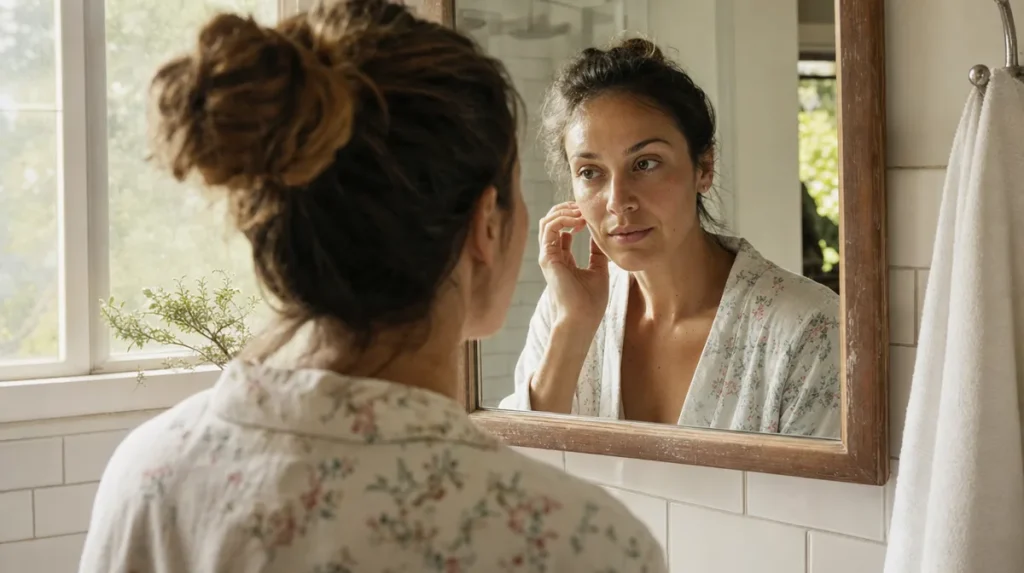
Indoor light, especially the warm bulbs in most bathrooms, shifts how pigment reads on skin. A balm that looks coral at home can look almost orange under office fluorescents, and the balm has not changed at all. The light has.
Think of a tinted balm like a sheer curtain over a window. The colour you see is a mix of the dye and whatever light is passing through the curtain, plus the colour of the room behind it, which in this case is your own lip tissue. Two people can own the identical balm and see two different results because the base colour of their lips is not the same.
Self-test: before you decide a balm is “wrong,” apply it near a window in natural daylight rather than under an indoor light, and check it again an hour later, after your own lip oils have mixed with the pigment. Many people judge a balm in the first ten seconds, which is before it has actually settled.
A 2021 study in the Journal of Cosmetic Science noted that consumer perception of lip colour shifted measurably between fluorescent and daylight viewing conditions, which is one reason in-store testers often disappoint once a person steps outside.
Why Lips Behave Differently Than Facial Skin
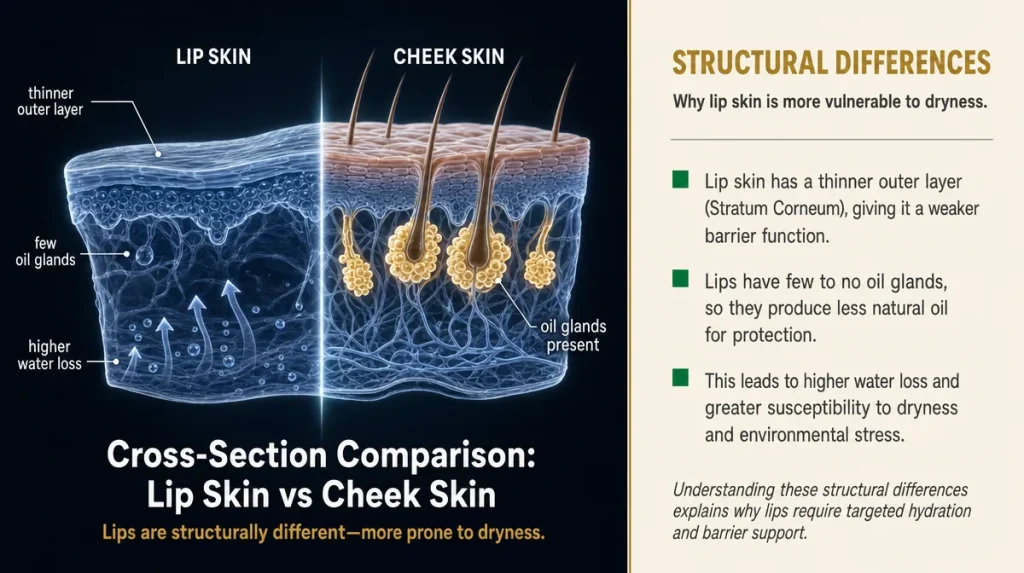
Lip skin has almost no oil glands and a much thinner outer layer than the skin on your cheek or forehead. That is why lips dry out faster and why the same balm can feel rich on your hand and thin on your mouth within an hour.
A useful comparison is suede versus leather. Both come from the same animal, but they need completely different care because of how the surface is built. Lip skin and facial skin are that different from each other, even though people treat them the same.
Research on transepidermal water loss, including a frequently cited study in the International Journal of Dermatology, has measured water loss from lip skin at several times the rate of nearby facial skin, which helps explain why lips chap faster and why tint seems to vanish from the centre of the mouth first, since that is the area under the most movement and moisture loss.
This also explains why a balm marketed as “long-wearing” can still fade visibly by midday. The product is fighting biology, not just friction from a coffee cup.
Prepping Before You Apply Colour
Tint grabs unevenly onto rough or flaking skin the same way paint grabs unevenly onto a wall that has not been sanded. If the surface is uneven, the colour will be too, no matter how good the formula is.
The basic sequence that tends to work: gently pat lips with a damp washcloth for a few seconds to loosen any dry flakes, let them air dry for a minute, then apply the balm in a thin layer rather than a thick one. Thick layers tend to pool in the fine lines of the lip and look patchy rather than saturated.
The mistake almost everyone makes is applying tinted balm directly over dry, flaking skin because it is faster. The pigment binds unevenly to the raised flakes and leaves darker specks once it settles, which many people mistake for a flaw in the product rather than a prep issue.
If lips are visibly peeling, a plain, unscented balm worn for a day before colour is applied tends to produce a smoother result than tint layered straight onto dry skin.
Pressing, Not Swiping: The Application Mistake
The motion you use to apply a tinted balm changes the finish more than people expect. Swiping drags pigment across the lip in one direction, which can leave streaks, especially with balms that have a higher dye concentration.
Pressing works more like a rubber stamp than a paintbrush. Apply the balm to the centre of the top and bottom lip, then press the lips together and rub them gently, the way you would blot lipstick with a tissue in reverse. This spreads colour more evenly to the outer corners, which are usually the thinnest part of the lip and the hardest to coat.
A second light press after thirty seconds, once the first layer has settled, tends to even out any patchiness without adding much bulk. Most people stop after one swipe, which is often the point where the result looks uneven.
This technique matters more with deeper or more saturated tints, where any unevenness is easier to see, and less with very sheer, barely-there formulas.
Making The Colour Survive Lunch
Tinted balm fades from the inside of the lip first because that is the area in direct, repeated contact with teeth, food, and cups. The outer edge of the lip, which touches less, often keeps colour longer, which is why a worn-off balm can look oddly outlined by late afternoon.
Blotting with a single-ply tissue right after application, then applying a second thin layer, helps the pigment bind to the lip rather than sitting on top where it transfers easily onto a glass or coffee cup. This two-step method is sometimes called the “blot and build” approach among makeup artists and tends to outperform one thick application.
Oily or very hot foods dissolve the waxy base of most balms faster than dry foods do, which is a formulation issue rather than a user error. Keeping a balm nearby for a quick touch-up after a meal, rather than expecting one application to last all day, is a more realistic approach than searching for a balm that claims to need no reapplication at all.
Reading The Tint On Your Own Skin, Not The Packaging
Many tinted balms are formulated to react with the natural pH of individual skin, which is why the same shade genuinely does look different from person to person, not just because of undertone but because of how the dye chemically shifts once it meets skin oils.
Testing a balm on the back of your hand tells you almost nothing useful, because hand skin and lip skin have different pH levels and different oil content. A more accurate test is a small dab on the inner edge of the lip, left for a minute before judging the colour.
A 2018 formulation review in Cosmetics journal described this pH-reactive dye technology, noting that colour development could vary meaningfully across individual users testing an identical product, which is a formulation feature rather than a flaw.
The practical takeaway is that swatching a tinted balm anywhere other than the lip is close to a guess, and judging a shade from a photo on packaging or a screen is even less reliable, since screens render colour inconsistently.
Storage Habits That Quietly Change The Texture
Heat separates the oils and waxes in a balm, which is why a tube left in a hot car can turn greasy on top and waxy underneath within days. Cold has the opposite effect, making a balm stiff and harder to spread evenly, which often gets blamed on the formula rather than the glovebox it spent the winter in.
Self-test: if a balm feels gritty, separated, or leaves an oily film that sits on top of the lip rather than sinking in, it has likely been through a temperature swing and is no longer performing the way it did when new.
Keeping tinted balms somewhere closer to room temperature, a bag pocket rather than a car door or a windowsill, preserves both the texture and how evenly the colour disperses. This is a free fix that often solves a complaint people assume requires buying a new product entirely.
Signs It Is Time To Let A Balm Go
Tinted balms are oil and wax based, and like any oil-based product they can turn rancid, usually signalled by a faint sour or crayon-like smell that was not there when the balm was new. A colour that has shifted slightly, gone duller or separated into a greasy layer, is another sign the formula has broken down.
Most balms carry a small open-jar symbol on the packaging, a drawing of an open container with a number followed by “M” for months, indicating how long the product is meant to be used once opened, typically somewhere between twelve and eighteen months.
The common mistake is assuming a balm cannot expire because “it’s just a lip balm.” Oils do oxidize over time, and applying an oxidized product to skin that is already thinner and more absorbent than most other areas of the body is worth avoiding, particularly for anyone prone to irritation. If in doubt, a plain patch test on the inner wrist for a day is a reasonable check before using an older balm again.
Key Takeaways
Most tinted balm disappointment traces back to five fixable habits rather than the product itself: testing shade under the wrong light, skipping lip prep, swiping instead of pressing, expecting one application to outlast a meal, and storing the balm somewhere too hot or too cold. None of these require spending anything new.
A Quick Checklist Before Your Next Application
- Test colour near a window in daylight, not under indoor bulbs
- Pat away dry flakes and let lips air dry before applying tint
- Apply in a thin layer and press lips together rather than swiping
- Blot, then add a thin second layer for staying power
- Check for the open-jar symbol and note how many months it is good for
- Keep the tube somewhere closer to room temperature, not a car or a windowsill
This article is for general information and does not replace advice from a dermatologist or other qualified health professional.
Individual results from any product or technique described here may vary.