
Dr. Priya Nandakumar, Senior Health and Science Editor.
You’re standing at the bathroom mirror, phone in hand, typing something like “why doesn’t my perfume last” or “best way to apply eau de parfum.” The shelf behind you tells its own story: three half-used bottles, one you loved for a season and barely notice now, another that smells different on you than it did on the tester card at the counter. None of this means you bought the wrong bottle. Eau de parfum is a mixture of alcohol, water and fragrance oil that behaves differently depending on how, where and when it goes on, and a handful of small habits decide whether a bottle performs the way it was built to. One fact worth knowing before anything else: rubbing your wrists together, the gesture almost everyone does on reflex, generates friction heat that breaks down the lightest, most fragile notes in the blend, so the opening of the scent you paid for is often gone before you leave the house. This guide walks through the habits that quietly waste eau de parfum, and the small adjustments that fix them.
- Dab, don’t rub: friction and heat from rubbing wrists together speed up evaporation of the top notes, cutting an opening you paid for short.
- Apply to bare, slightly damp skin, roughly 15 to 20 centimetres from the nozzle: both distance and skin moisture change how evenly fragrance oil settles and binds.
- Store the bottle away from heat, light and humidity, never on a bathroom shelf: temperature swings and sun exposure are what actually shorten a perfume’s useful life, not time alone.
Rubbing Your Wrists Together Undoes Half The Scent
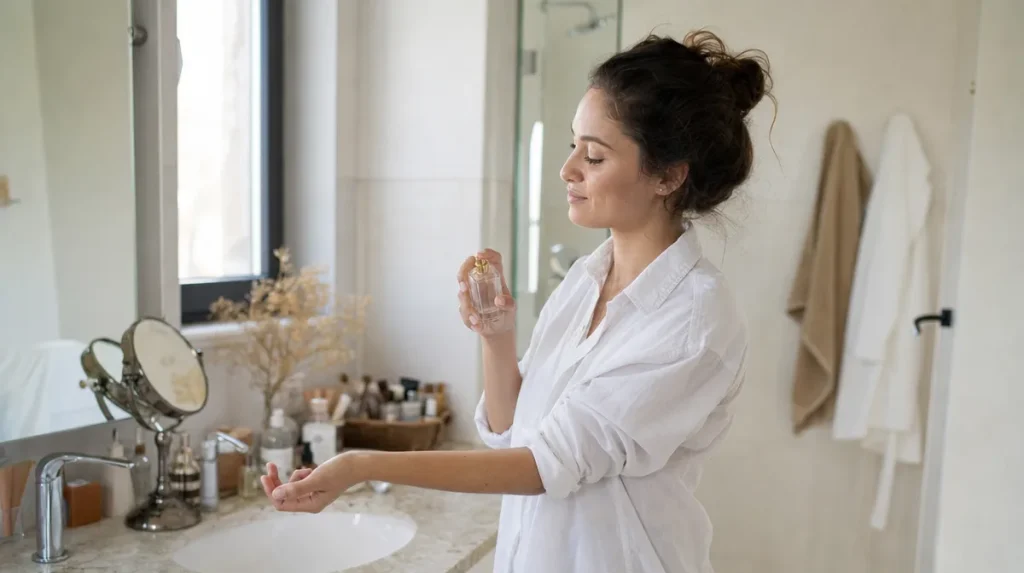
The reflex is almost universal: spray both wrists, then rub them together like warming your hands. It feels thorough. It is actually one of the most common ways people damage their own fragrance before anyone else smells it.
Eau de parfum is built in layers. The top notes, often citrus, light florals or green accords, are the most volatile molecules in the blend, designed to evaporate first and fastest. Friction generates heat, and heat speeds up that evaporation further, so rubbing effectively burns through the opening notes before they’ve had a chance to do their job. Think of it the way a cook treats a delicate herb garnish: tossed into a hot pan it wilts and darkens almost instantly, but laid on gently at the end its oils release slowly. Perfume top notes work much the same way.
The fix costs nothing: spray and let the skin absorb the scent on its own, patting gently at most if a spot feels too wet.
Self-test: spray one wrist and leave it alone. Spray the other and rub it against your opposite wrist for ten seconds. Smell both after two minutes, then again after fifteen. The rubbed wrist usually smells flatter and more alcohol-forward right away, and tends to fade sooner.
Spraying From The Wrong Distance Wastes Most Of A Spritz
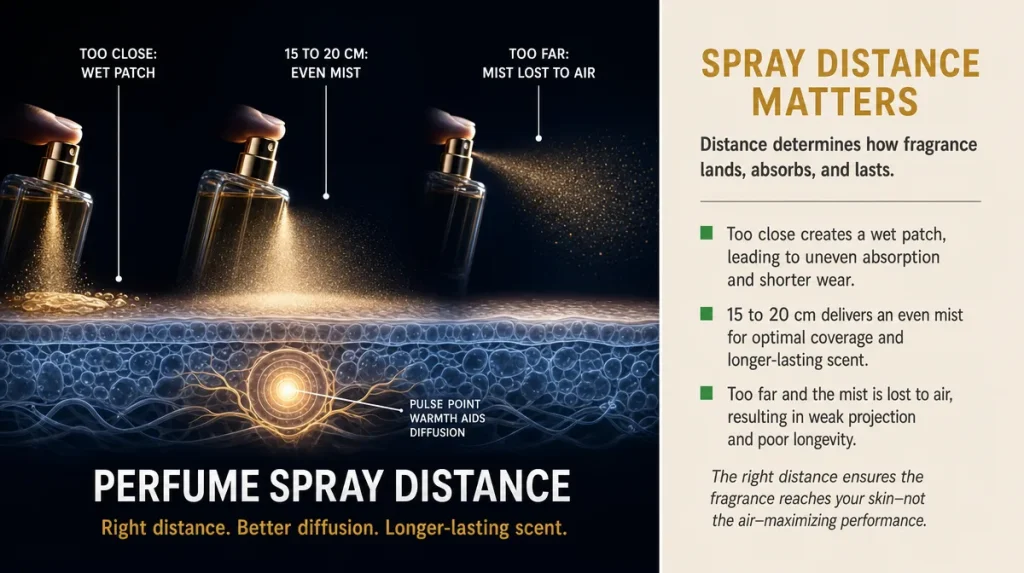
Most people spray too close, holding the nozzle almost against the skin. At that distance the mist lands as a concentrated wet patch rather than an even veil, and a disproportionate amount of alcohol pools in one spot instead of dispersing across the skin’s surface.
A pharmacist dispensing a nasal spray works from a similar principle: distance changes droplet size and spread. Held roughly 15 to 20 centimetres from the skin, a spray breaks into a finer mist that settles more evenly, giving the fragrance oil more surface area to bond with and leaving less raw alcohol sitting in a single wet circle.
Spraying too far away wastes product in the opposite direction: much of the mist never reaches skin at all, drifting into the air or settling on clothing instead.
A 2021 study in the International Journal of Cosmetic Science measured fragrance deposition at varying spray distances and found the most even, longest-lasting deposition occurred in that middle range, neither pressed against the skin nor sprayed from arm’s length.
Pulse points, the inside of the wrists, the base of the throat, behind the ears, work well mainly because they run warmer, and warmth helps a fragrance diffuse gradually through the day rather than all at once.
Storing The Bottle In A Steamy Bathroom Shortens Its Life
A bathroom looks like the natural home for a perfume bottle: it sits beside the toothbrush, part of the same morning routine. It is actually one of the worst places to keep one.
Fragrance oils break down through heat, light and humidity, roughly in that order of damage. A bathroom delivers all three: hot showers raise temperature and moisture repeatedly through the week, and many bathroom windows let in direct sun. Over months that combination can shift a scent’s balance, often making it smell sharper, thinner or slightly off compared with how it smelled on day one.
A drawer or closet shelf is more reliable, somewhere dark, dry and close to room temperature. A linen cupboard works well. A windowsill does not.
Canadian winters add a wrinkle many people overlook: a bottle left in a cold car, or near a drafty window, cycles through temperature swings that can be just as damaging as heat, since repeated expansion and contraction stresses the liquid and the seal around the cap.
None of this means a bottle needs babying. It means treating it more like good olive oil than hand cream: away from the stove, away from the window, lid on tight.
Topping Up All Day Instead Of Trusting The First Application
By early afternoon, many women reach for the bottle again, convinced the scent has disappeared. Often it hasn’t. The nose simply adjusts to a familiar smell over time, a process called olfactory fatigue, the same reason you stop noticing your own kitchen but a guest walks in and comments right away.
Reapplying on top of a scent that’s merely gone quiet to your own nose, rather than genuinely faded, can oversaturate the air around you without you realizing it, since other people’s noses haven’t adjusted the way yours has.
A steadier approach is applying once, generously, to two or three pulse points in the morning, and resisting the urge to judge longevity by nose alone. For a genuine read on whether a scent has faded, ask someone close to you, or step outside for ten minutes and come back in. Fresh air resets your own sense of smell faster than waiting it out indoors.
If a scent does genuinely fade by midafternoon, one light reapplication near the collar or hairline, rather than repeating the exact wrist application, tends to refresh it without muddling the layers that are already settled into the skin.
Ignoring How Your Own Skin Chemistry Changes A Scent
The same eau de parfum can smell noticeably different on two people, and this isn’t inconsistency in the product. Skin pH, natural oil production, and even diet and certain medications can all shift how fragrance oils read on an individual’s skin, a point dermatology researchers have noted when studying how topical products interact with the skin’s surface more broadly.
Drier skin tends to hold fragrance less well than oilier skin, since fragrance molecules bind partly to the skin’s own oils. This is one reason perfume applied right after a shower, onto skin that still carries some residual moisture and body heat, tends to last longer than perfume applied to fully dry skin hours later.
A simple comparison: scent clings to wool longer than to a tightly woven synthetic fabric, because wool offers more surface texture to hold onto. Oilier skin behaves a little like wool in this comparison, and very dry skin more like the synthetic.
This is also why a paper strip at a counter only tells part of the story. The strip has no oil, no warmth and no individual chemistry, so a scent that reads one way on paper can shift once it meets actual skin. The reliable test is wearing it for several hours, ideally a full day, before deciding.
Matching Sillage To The Room, Not Just The Season
Sillage, the trail a fragrance leaves as you move through a space, matters more in some settings than others, and mismatching it is a quieter mistake than most people realize. A scent built for an evening out, heavier with warm, resinous or musky notes, can feel overwhelming in a small meeting room or a quiet office, not because the fragrance is poorly made but because the space doesn’t give it room to dissipate.
Lighter eau de parfum structures, citrus, green or soft floral, tend to suit close, shared spaces better, simply because they diffuse over a shorter distance.
Beauty desks at Canadian publications including Chatelaine and The Kit have, in general style coverage over the years, pointed readers toward choosing scent strength based on the size and type of a space rather than the time of day alone, a practical note that holds beyond any single season’s trend coverage.
A useful habit: before applying, think less about what the calendar says and more about the room ahead. An open-plan office, a packed elevator or a small car all call for a lighter hand than a large room or an outdoor event, regardless of whether it’s July or January.
Layering Scented Products That Compete With The Perfume
Eau de parfum rarely works alone. Scented body wash, lotion, hair product and even laundry detergent all layer onto skin and clothing before the perfume ever gets sprayed, and each carries its own fragrance profile that can clash with or simply drown out the eau de parfum applied on top.
A citrus-forward perfume applied over a heavily vanilla-scented body lotion doesn’t read as citrus with a vanilla base. It often reads as a muddled, generic sweetness that neither product intended on its own. This is less about any single product being wrong and more about accumulation: three or four fragranced layers compete for the same space.
The simplest fix is letting one fragrance lead and keeping everything else close to unscented, particularly body wash and lotion applied right before dressing. If a scented lotion is a daily habit, choosing one in the same fragrance family as the perfume, both soft and floral, or both warm and spiced, avoids the clash rather than requiring the lotion to go.
Hair holds fragrance differently than skin does, often longer, since hair fibres trap volatile molecules more readily. A light mist through the ends of dry hair can extend a scent’s presence through the day without reapplying directly to skin.
Mistaking A Changed Scent For A Flawed Bottle
A bottle that smells slightly different six months into regular use hasn’t necessarily gone bad. Eau de parfum is a complex mixture, and the balance between top, heart and base notes shifts subtly as a bottle is opened and closed repeatedly and exposed to air each time.
There’s a difference, though, between gradual settling and genuine spoilage. A scent that smells notably sharper, almost like rubbing alcohol, or has taken on a sour or vinegar-like note, has likely oxidized, usually from heat exposure, direct sunlight or simply age. Most eau de parfum, properly stored, holds its character reasonably well for three to five years, though natural materials in a blend, citrus oils especially, tend to shift sooner than synthetic musks or woods.
Colour can offer a clue too: a fragrance that has darkened noticeably beyond its original shade has often been exposed to more light or heat than it should have been.
None of this is about discarding a bottle at the first sign of change. It’s about telling ordinary evolution from an actual problem, the way you’d judge a bottle of wine by smell and colour rather than by the date alone. When in doubt, testing a small amount on a paper strip, away from skin, gives the clearest read on whether the fragrance itself has shifted or whether it’s simply a tired nose doing the judging.
Key Takeaways
- Apply, don’t rub: friction and heat break down the lightest top notes before they can open properly.
- Spray from roughly 15 to 20 centimetres for an even mist, closer leaves a wet patch, farther wastes product into the air.
- Keep the bottle somewhere dark, dry and temperature-stable, a bathroom shelf is one of the harder places on a fragrance.
- Apply once, generously, rather than topping up through the day to chase a nose that has simply adjusted.
- Remember that skin chemistry, not just the formula, decides how a scent actually reads on you.
- Match strength to the room you’re walking into, not only the season on the calendar.
- Let one fragrance lead, and keep other scented products in the same family or close to unscented.
- Learn to tell gradual, normal evolution from genuine oxidation, a sharp or sour note is the real signal to watch for.
A Quick Checklist For Better Wear
- Spray onto bare or slightly damp skin, ideally soon after a shower.
- Hold the bottle about a hand’s width from the skin, not pressed against it.
- Pat, never rub, if a pulse point feels too wet.
- Store the bottle in a drawer or closet, away from windows, radiators and the bathroom.
- Test longevity on skin for a full day before judging a scent, not on a paper strip alone.
- Choose strength based on the size of the space you’re heading into.
- Keep competing scented products, lotion, hair care, laundry detergent, in the same fragrance family.
- Watch for a sharp, alcohol-like or sour note as the real sign a bottle has turned, not simply a change in character over time.
This article is for general information only and does not replace advice from a dermatologist or fragrance professional.
Individual experiences with fragrance and skin chemistry may vary.